

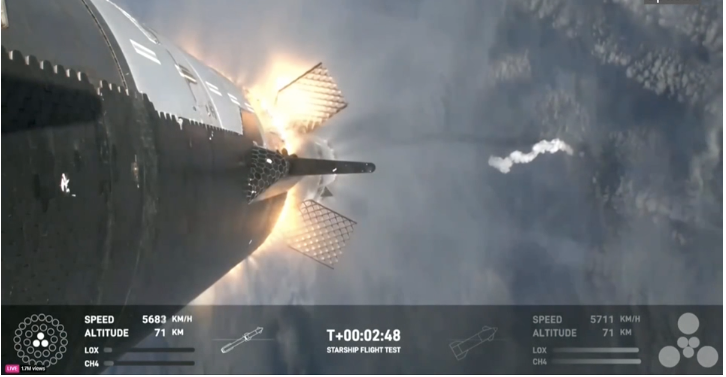
In a significant leap forward for space exploration, SpaceX’s Starship rocket achieved notable success during its third test flight on Thursday, marking a major milestone in the company’s ambitious endeavors.
Launching from its Texas launch site, the two-stage Starship rocket demonstrated impressive performance, fulfilling many of its objectives with precision. The upper portion of the vehicle successfully completed a journey around the globe, culminating in a controlled re-entry over the Indian Ocean.
Although radio contact was momentarily lost towards the end of the flight, SpaceX expressed satisfaction with the overall outcome, noting the remarkable progress achieved during the mission.
Elon Musk, CEO of SpaceX, shared his delight with the successful flight, underscoring the significance of the achievement for the company’s future endeavors in space exploration.
The successful test flight of Starship represents a significant step forward in SpaceX’s efforts to develop innovative technologies for space travel. With each successful milestone, the company moves closer to realizing its vision of enabling human exploration and colonization of other planets.
As SpaceX continues to push the boundaries of space exploration, the world eagerly awaits further advancements and breakthroughs that will shape the future of space travel and inspire generations to come.
He posted on X, formerly Twitter, that “Starship will take humanity to Mars”.
- Who is Elon Musk?
- Europe to develop commercial space capsule
- Plan to send all-UK astronaut mission into orbit

In a remarkable display of progress, SpaceX’s Starship rocket achieved a significant milestone during its latest test flight, marking a notable improvement from previous attempts that ended in failure.
Launching in April and November of the previous year, the 120-meter-tall (395-foot) vehicle experienced catastrophic failures shortly after liftoff. However, with the latest test flight, SpaceX CEO Elon Musk aimed for substantial improvement – a goal that was successfully met by his dedicated team.
The rocket’s departure from its launch mount was accompanied by a resounding rumble from its 33 engines, signaling a promising start to the mission. As it ascended into space, the vehicle flawlessly navigated through each phase of the climb, surpassing expectations at every turn.
At two minutes and 44 seconds into the flight, the bottom half of the rocket, known as the booster, separated from the top half, the Ship, precisely as planned. From there, the Ship continued its journey, traversing the Atlantic Ocean and southern Africa.
Throughout the flight, video cameras onboard transmitted breathtaking views of Earth from an altitude of over 100 miles, providing a captivating glimpse of our planet from space.
The success of Starship’s latest test flight represents a significant step forward for SpaceX and its ambitious goals in space exploration. With each successful mission, the company edges closer to realizing its vision of enabling human exploration of other planets and beyond.
As SpaceX continues to push the boundaries of space travel, the world eagerly anticipates further advancements and achievements that will shape the future of interplanetary exploration.
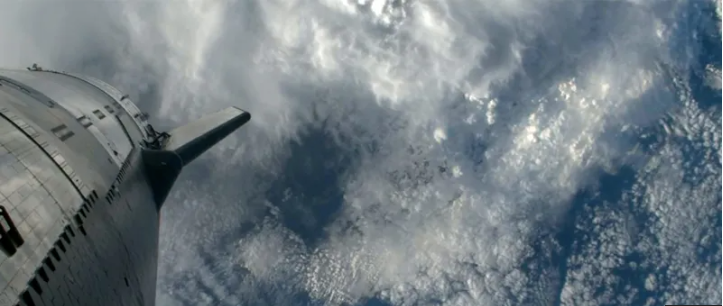
Then came the task of re-entry, when the ship needed to descend to a splashdown in the ocean.
Video imagery once again captured incredible scenes as hot gases enveloped the vehicle, just before radio contact was interrupted.
Controllers reported shortly after that the Ship had been “lost”, presumably because it had broken up.

SpaceX’s recent test flight of the Starship rocket showcased both advancements and challenges in the pursuit of revolutionizing space exploration. While several milestones were successfully achieved, including a clean ascent and separation of components, there were also notable setbacks that provide valuable insights for future development.
One of the anticipated milestones was the controlled descent of the booster back to Earth, aiming for a controlled drop into the sea near the Texas coast. Despite coming close, the booster appeared to descend too rapidly and was lost before reaching the water. Similarly, the Ship was expected to re-ignite an engine for re-entry, but this step was skipped for reasons not immediately clear.
However, these issues serve as valuable learning opportunities, with engineers poised to analyze data and address any shortcomings. Overall, the test flight reaffirmed that the development of the world’s most powerful rocket is on track, with SpaceX CEO Elon Musk pledging additional test flights in the coming year.
Starship’s revolutionary design sets it apart from previous rocket systems, boasting 33 engines at the base of the booster that produce unprecedented thrust. If perfected, Starship has the potential to revolutionize space travel, offering full reusability akin to an airplane and significantly reducing the cost of accessing space.
For Musk, Starship plays a pivotal role in his ambitious Starlink project, which aims to establish a global network of broadband internet satellites. The recent test flight demonstrated the capability to open and close a payload bay door, paving the way for future deployment of Starlink satellites.
Moreover, Starship holds the promise of fulfilling Musk’s long-standing ambition of establishing a human settlement on Mars. With NASA closely observing developments, Starship’s role in the Artemis program to return astronauts to the Moon is of paramount importance. SpaceX must demonstrate the safety and reliability of the vehicle before astronauts can embark on lunar missions, with NASA targeting late 2026 for crewed flights.
While the mission faced challenges, including mishaps during descent, the Federal Aviation Administration announced a standard mishap investigation, underscoring SpaceX’s commitment to safety and continuous improvement in commercial spaceflight.
In conclusion, SpaceX’s Starship test flight represents a significant step forward in the quest for space exploration innovation. As engineers refine the technology and address challenges, the potential of Starship to transform humanity’s journey into space remains unparalleled.













Leave a comment