


Inside Bangladesh it’s being dubbed a Gen Z revolution – a protest movement that pitted mostly young student demonstrators against a 76-year-old leader who had dominated her nation for decades and turned increasingly authoritarian in recent years.
There was jubilation on the streets of the Bangladeshi capital Dhaka on Monday after Prime Minister Sheikh Hasina resigned and fled the country by helicopter following weeks of deadly anti-government unrest.
Hasina’s abrupt exit ends 15 years in power that has been marked by a stifling of civil freedoms and the heavy-handed use of security forces to crush dissent, critics and rights groups say.
An interim government headed by Nobel Peace Prize laureate Muhammad Yunus will now lead the country at the request of student protest leaders, the Bangladesh president’s press secretary confirmed to CNN on Tuesday.
Meanwhile, the country’s main opposition party has offered its full support to student protesters.
What began as peaceful protests by students against civil service job quotas morphed into a nationwide push to force Hasina out after demonstrators were met with a government crackdown that killed about 300 people, according to local media and agencies.
Hasina blamed the opposition for the violence and imposed internet blocks and an indefinite curfew across the country.
Her response inflamed the protesters further and, in the end, the world’s longest-serving female head of government had to quickly flee the country with her sister to India before crowds stormed her official residence, smashing walls and looting its contents.
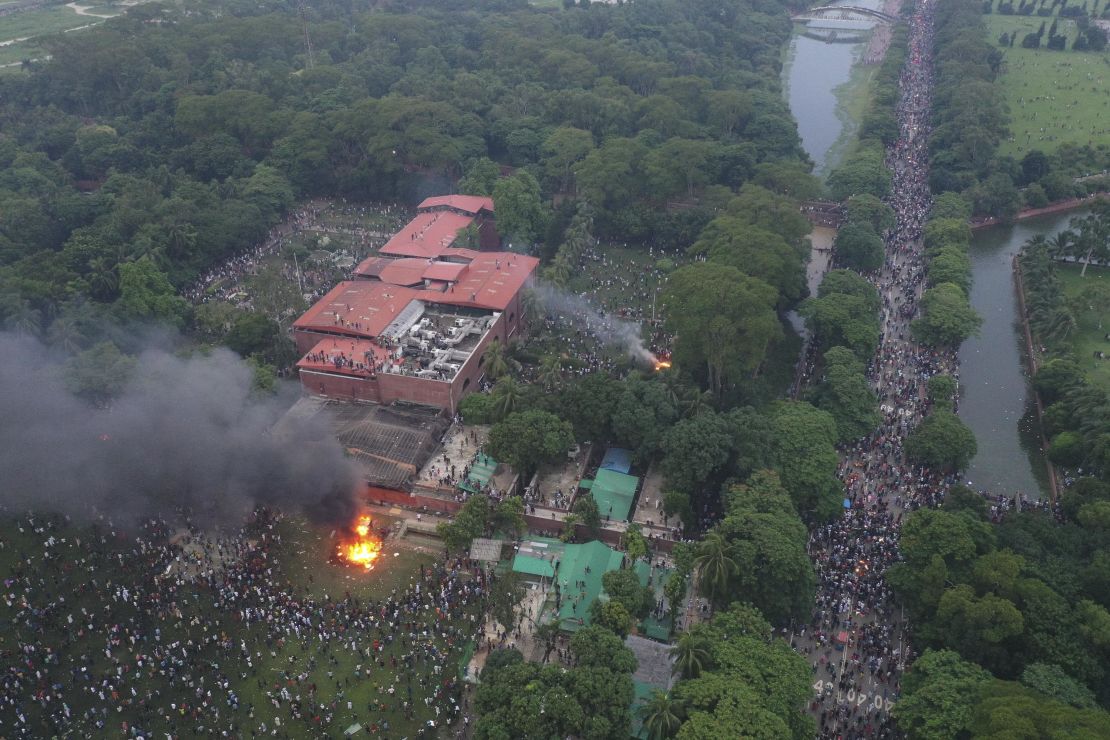
Fires burn outside the Prime Minister’s House after Sheikh Hasina resigned and fled the country, on August 5, 2024 in Dhaka, Bangladesh. Parvez Ahmad Rony/Drik/Getty Images
Why were Bangladeshis on the streets?
Students began protesting on July 1 at the prestigious Dhaka University demanding an end to the government’s quota system, which reserves 30% of civil service posts for relatives of veterans who fought in Bangladesh’s war of independence from Pakistan in 1971.
Many of the country’s contemporary political elite are related to that generation – including Hasina, a daughter of Sheikh Mujibur Rahman, the widely regarded founder of modern Bangladesh who was assassinated in 1975.
The reserved roles were linked to job security and higher pay, and protesters said the quota system is discriminatory and favors supporters of Hasina’s ruling Awami League party.
Driving the anger was high unemployment levels in the country, especially among young people. Bangladesh has seen strong economic growth under Hasina, but it slowed in the post-pandemic era and is beset with high inflation and depleted foreign currency reserves. In a nation of 170 million people, more than 30 million are not in work or education.
The protests turned violent on July 15 and the government’s increasingly deadly response fueled their anger further, even after the Supreme Court rolled back most of the controversial quotas on government jobs and internet blocks were lifted.
On Sunday, at least 91 people were killed and hundreds injured in clashes between police and protesters, the highest for a single day from any protests in the country’s recent history.
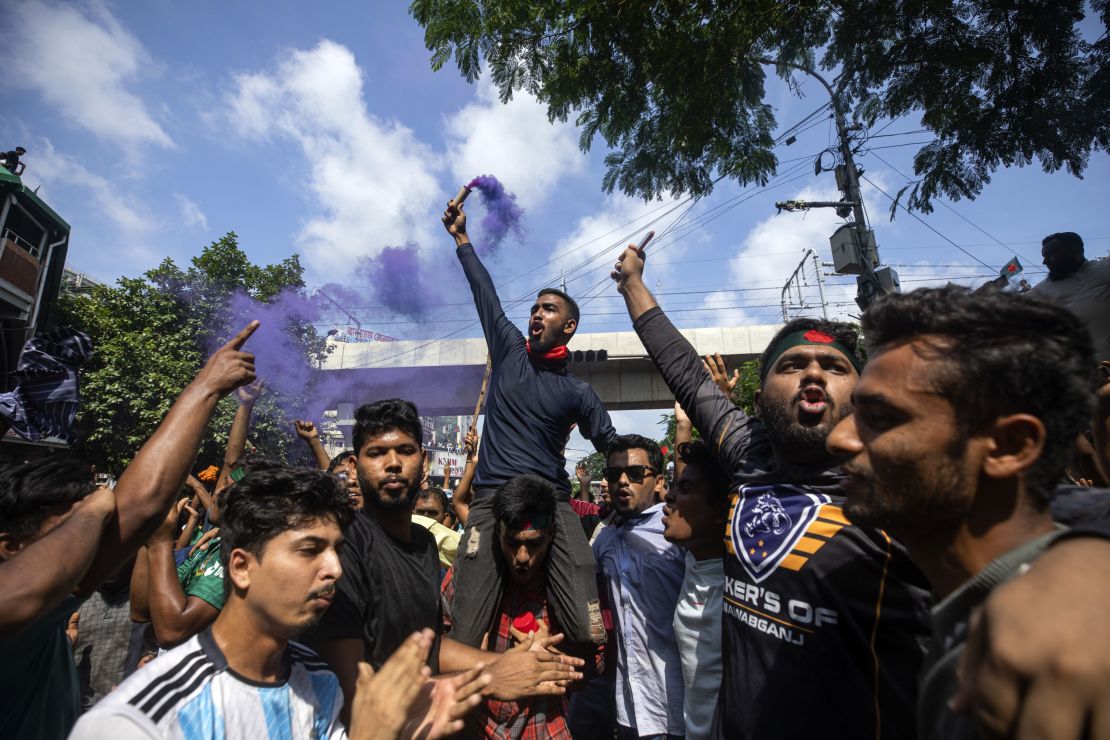
Protesters shout slogans as they celebrate Prime Minister Sheikh Hasina’s resignation in Dhaka. Rajib Dhar/AP
‘Blood in front of my university’
After Hasina’s resignation on Monday, celebration soon gave way to more violence as protesters torched several buildings, including the Bangabandhu Memorial Museum – the ancestral residence of Hasina’s father Mujibur Rahman – and Awami League offices, eyewitnesses told CNN.
“Things turned ugly really quickly,” said Raiyan Aftab, 23, a student at BRAC University, who said police shot at protesters outside the campus. “They shot everybody. There is blood in front of my university right now. There’s like 30 bodies… I couldn’t sleep all night.”
Across the capital, anti-government protesters were attacked by police and military personnel, witnesses said. At Dhaka Medical College, police opened fire on protesters, according to a CNN fixer at the scene.
Students and protesters at Dhaka University Campus and the Shaheed Minar, a national monument in the capital, were beaten by police as they assembled at these locations.
“I went to Shaheed Minar with my friends to celebrate. It was epic. There’s like thousands of people there, everybody went, regardless of class, heritage, religion, we’re all together and all the students met up with flags and everything. It was a historic moment,” said Aftab. “But it was short lived.”
Meanwhile, images appeared online of young people guarding Hindu temples as misinformation swirled online and a mob attacked a temple, according to the director of the Meherpur ISKCON temple.
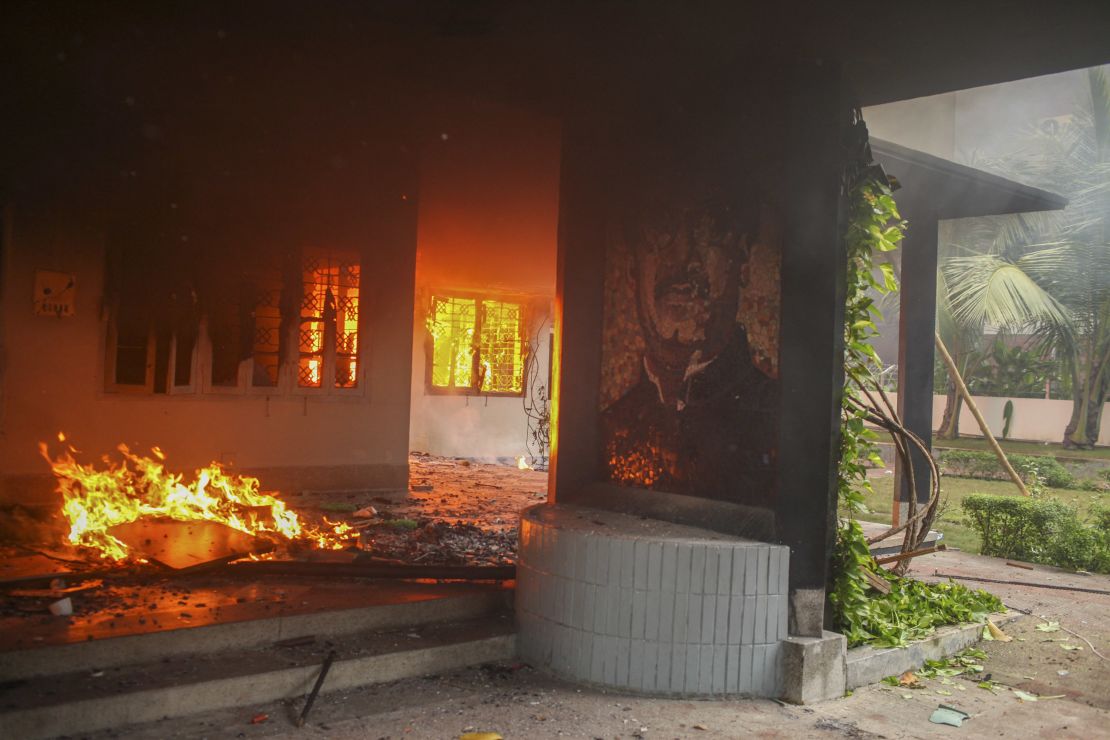
The Bangabandhu Memorial Museum burns in Dhaka on August 5, 2024. Abu Sufian Jewel/Middle East Images/AFP/Getty Images
Hasina’s legacy
The demonstrations became the ultimate challenge to Hasina since she secured a fourth consecutive term in January elections, which were boycotted by the main opposition party to protest what they said was a widespread crackdown on their ranks.
On Tuesday, Bangladesh President Mohammed Shahabuddin dissolved parliament and announced the release of opposition leader and former Prime Minister Khaleda Zia – a longtime Hasina rival – who had been jailed in 2018 on graft charges, which she denies. Other student protesters and those arrested on “false cases,” were also released, the president said.
Hasina’s political career spanned decades since returning from exile in the early 1980s following the assassination of her father and most of her family. In 1990 she led a popular democratic uprising against military rule and has survived several assassination attempts in the years since.
She first became prime minister in 1996 and served for one term before returning to power in 2008, ruling Bangladesh with her Awami League party until Monday.
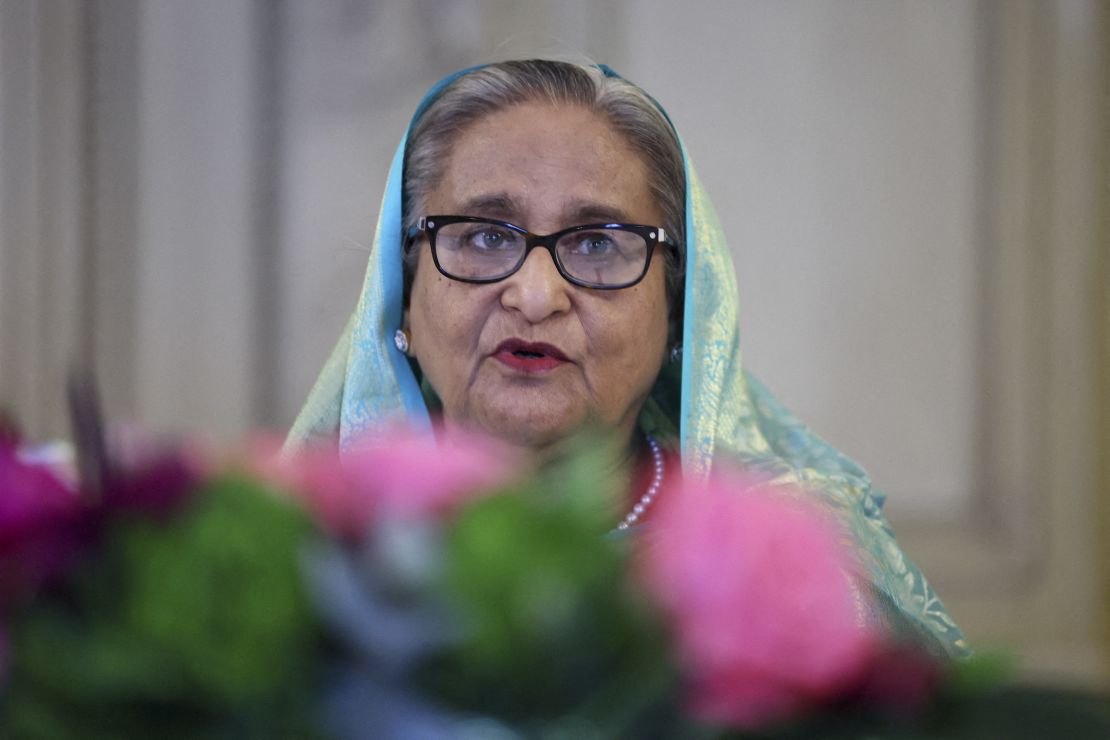
Sheikh Hasina in Munich, Germany on February 17, 2024. Wolfgang Rattay/Reuters
Human rights organizations have warned that Hasina and her government were headed toward a one-party system, and critics expressed concerns over increased reports of political violence, voter intimidation, and harassment of the media and opposition figures.
During her time in power, rights groups say the government has used its cyber security law to crack down on freedom of expression online, arresting journalists, artists and activists, with reported cases of arbitrary detention and torture.
But Hasina had managed to weather many previous protests against her rule that erupted particularly during elections, so her resignation after five weeks of unrest was seen as sudden and unexpected.
Young people, who witnessed their peers shot and killed, fueled by dismal job prospects and who were tired of corruption and repression, could not be stopped by curfews, internet blocks or security forces.
“This might very well be the first successful Gen Z led revolution,” said Sabrina Karim, associate professor of government at Cornell University, who specializes in the study of political violence.
The military may have also played a role in Hasina’s resignation. Karim said in a statement that it “appears that the military were not always a unified force backing the Hasina regime.”
“While there are many photos and videos circulating of soldiers using deadly force and shooting at unarmed protesters, some members of the military called for an independent UN-led investigation into these atrocities,” she said. “In addition, some members of the military announced yesterday that they would not use deadly force on protesters who convened on the capital.”
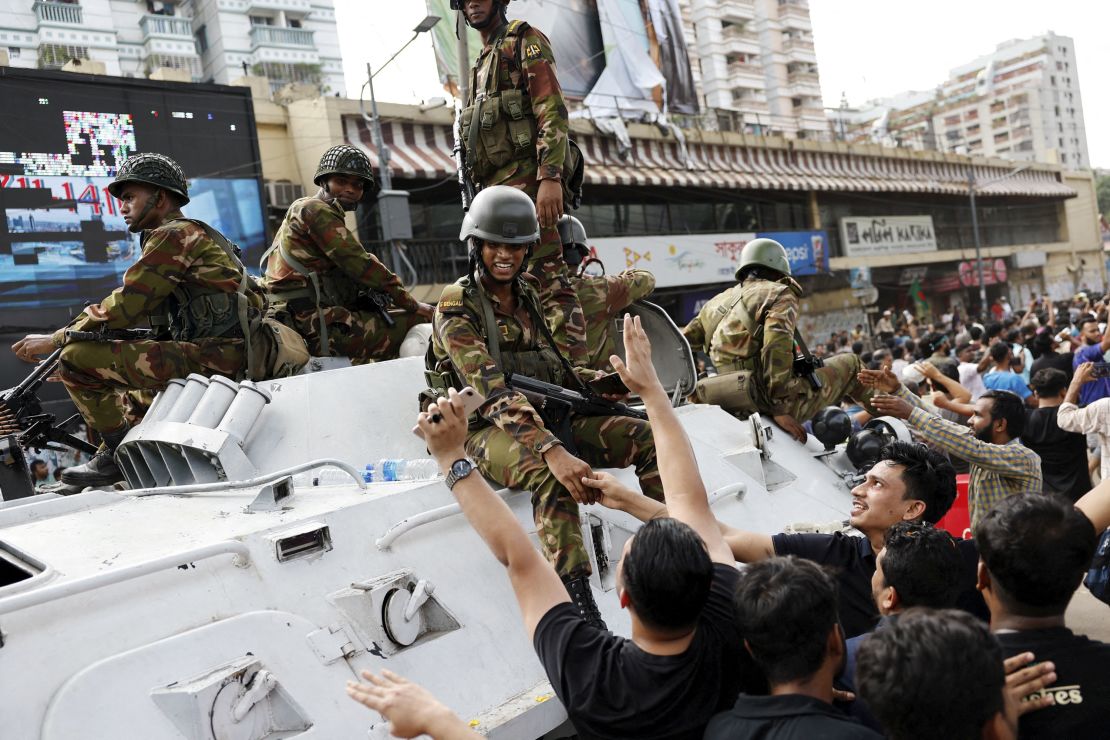
People shake hands with army personnel as they celebrate the resignation of Bangladeshi Prime Minister Sheikh Hasina in Dhaka on August 5, 2024.












Leave a comment