

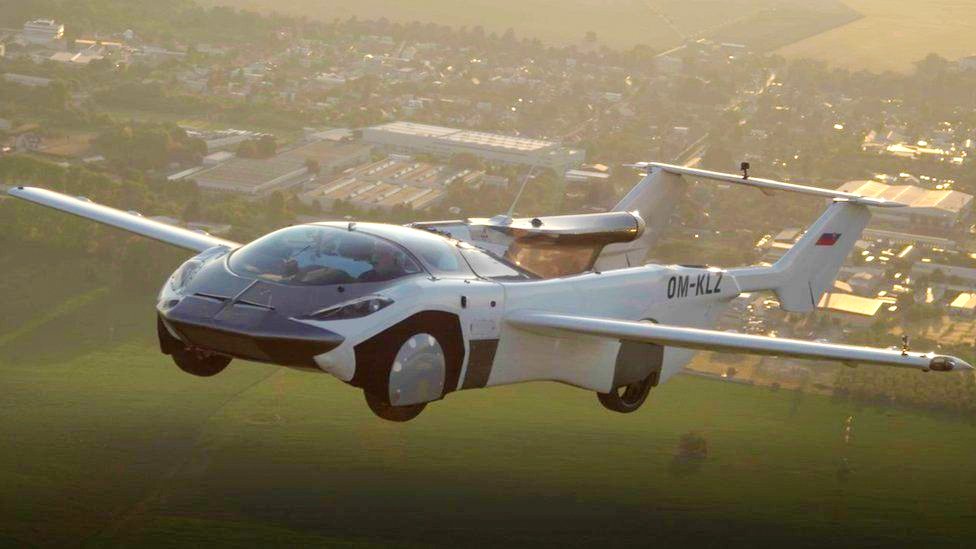
A groundbreaking flying car technology, originally developed and successfully trialed in Europe, has been acquired by a prominent Chinese firm, signaling a significant leap forward in aerial transportation innovation.
The AirCar, powered by a BMW engine and conventional fuel, demonstrated its capabilities with a 35-minute flight between two Slovakian airports in 2021, seamlessly transitioning from a car to an aircraft in just over two minutes, utilizing traditional runways for take-off and landing.
Hebei Jianxin Flying Car Technology Company, based in Cangzhou, has secured exclusive rights to produce and operate AirCar vehicles within a designated geographical area in China. The acquisition marks a strategic move for the company, which has previously established its own airport and flight school following an acquisition from another Slovak aircraft manufacturer.
Anton Zajac, co-founder of KleinVision, the company behind AirCar, affirmed the significance of this technology transfer, highlighting China’s active pursuit of innovative transport solutions, mirroring its leadership in the electric vehicle (EV) revolution.
China’s commitment to aerial mobility is further evidenced by recent milestones, including Autoflight’s successful test flight of a passenger-carrying drone between Shenzhen and Zhuhai, reducing a three-hour car journey to a mere 20 minutes. Similarly, eHang, a Chinese firm, attained a safety certificate from Chinese authorities for its electric flying taxi in 2023.
Meanwhile, in the UK, the government anticipates the integration of flying taxis into everyday airspace by 2028, underscoring the global momentum toward embracing advanced aerial transportation technologies.
As China embraces European innovation in flying car technology, the stage is set for transformative developments in regional transport infrastructure, promising enhanced connectivity and efficiency for urban and remote communities alike.
Government Sets Ambitious Timeline for Flying Taxis, Amidst Technological Advancements
In a bold move aimed at revolutionizing personal transportation, the government has announced plans to introduce flying taxis within a mere two years. However, unlike drone-like passenger aircraft, the AirCar, a pioneering technology that requires a runway for take-off and landing, is set to play a pivotal role in this transformative endeavor.
While KleinVision, the company behind AirCar, has declined to disclose the financial details of the technology’s sale, the aircraft received a certificate of airworthiness from the Slovak Transport Authority in 2022 and gained widespread attention after being featured in a video by YouTuber Mr. Beast.
Despite the promising advancements, significant obstacles remain in terms of infrastructure development, regulatory frameworks, and public acceptance of this emerging technology. Aviation consultant Steve Wright emphasizes that the evolving landscape of personal transport is reshaping conventional norms, with global efforts to regulate the sector leading to a myriad of new questions and challenges.
Wright further notes that while the West may face hurdles in adapting existing regulatory frameworks to accommodate flying taxis, China, renowned for its agility in embracing technological innovation, may view this as an opportunity to gain a competitive edge, much like its leadership in the electric vehicle market.
Drawing parallels with the evolution of electric cars, which initially faced skepticism but have since become a global market phenomenon, the sale of AirCar from Slovakia to China raises speculation about the latter’s potential dominance in the flying car sector.
However, Wright tempers expectations by suggesting that the practical implementation of flying taxis is likely to entail mundane realities such as queues and security checks. Despite the excitement surrounding prototypes like AirCar, the journey towards widespread adoption may involve navigating logistical challenges inherent to any transformative technology.
As governments and industries worldwide navigate this dynamic landscape, the future of personal transportation promises to be both exhilarating and complex, with innovations like flying taxis poised to redefine mobility in the years to come.













Leave a comment