

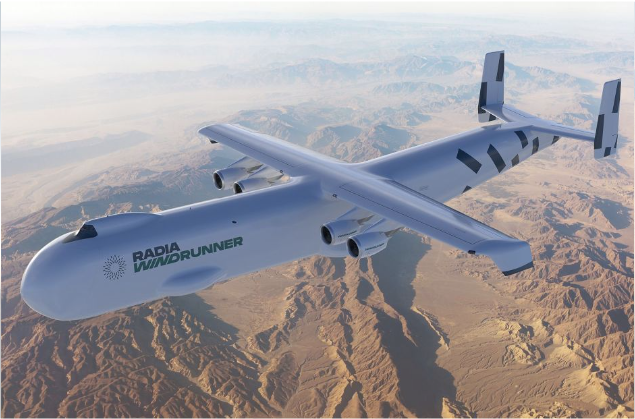
Introducing the groundbreaking WindRunner aircraft, a colossal innovation in aviation engineering poised to revolutionize the renewable energy sector. Developed by Radia, a visionary Colorado-based energy startup, the WindRunner aims to address the logistical challenges facing the expansion of onshore wind farms.
In response to the global energy crisis, where the demand for sustainable power sources is paramount, larger wind turbines have emerged as a key solution. However, their oversized components pose a significant transportation hurdle, rendering standard road transport impractical.
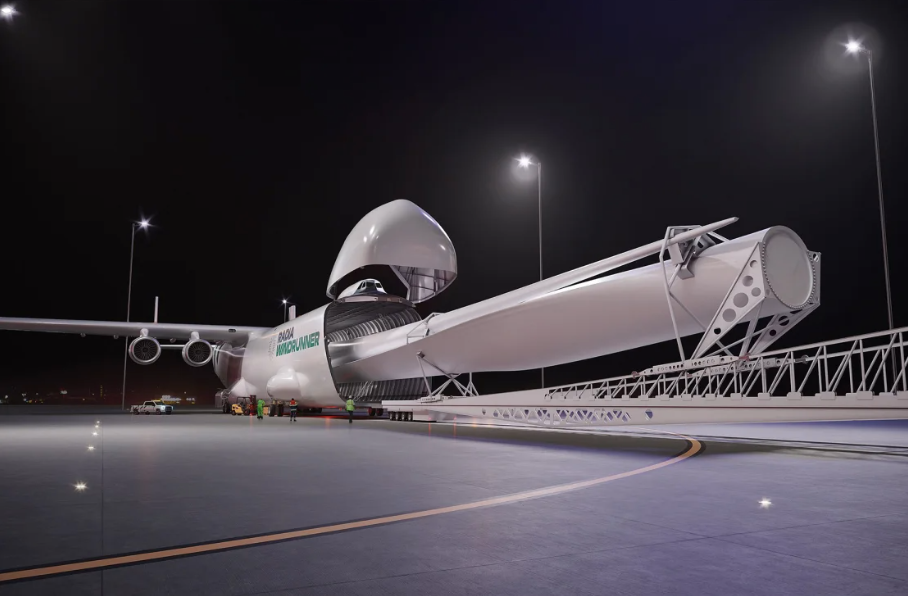
Enter the WindRunner, designed to be the largest aircraft ever constructed, with a singular mission: transporting massive 300-foot-long blades directly to wind farm locations. This ambitious endeavor not only facilitates the installation of larger, more powerful turbines but also accelerates the transition towards cleaner energy solutions.
Operating on sustainable aviation fuel, the WindRunner embodies Radia’s commitment to environmental stewardship. Moreover, its remarkable versatility enables it to land on modest packed-dirt or gravel runways, eliminating the need for extensive airport infrastructure.
As Radia envisions, the WindRunner will serve as a vital link in the renewable energy supply chain, operating from strategically positioned regional hubs to deliver components wherever they are needed. Notably, its exceptional maneuverability allows it to land on airstrips as short as 6,000 feet (1,800 meters), a feat unmatched by any other commercial aircraft of its size.
With the WindRunner, Radia heralds a new era in sustainable aviation and renewable energy deployment, propelling us closer to achieving our collective decarbonization goals.
Exploring WindRunner’s Impressive Specifications: Redefining Airborne Cargo Capacity
When it comes to transporting monumental payloads through the skies, WindRunner refuses to compromise on size or strength.
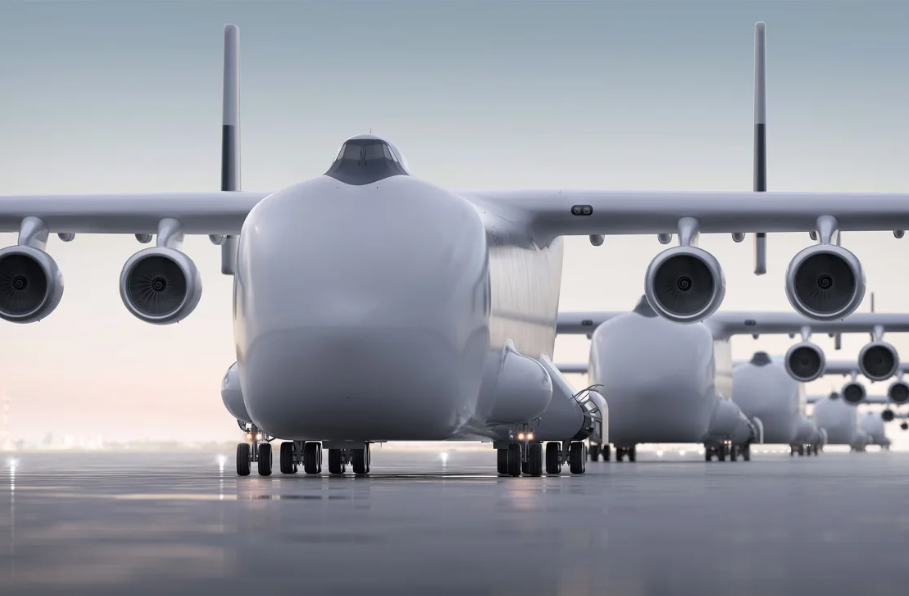
Prepare to be astounded by WindRunner’s colossal cargo bay, boasting a staggering volume of 272,000 cubic feet – ample space to accommodate three Olympic swimming pools. To put it into perspective, this dwarfs the capacity of a Boeing 747-400 by a factor of 12 and surpasses it in length by an impressive 127 feet, stretching a remarkable 356 feet from nose to tail.
And let’s talk wingspan – a monumental 261 feet, likened to the length of four bowling lanes laid end to end.
WindRunner’s sheer magnitude eclipses even the Antonov An-225, renowned as the heaviest aircraft ever constructed, now regrettably lost during the conflict in Ukraine.
While WindRunner’s scale is groundbreaking, its engineering is deliberately rooted in reliability. Radia’s strategic focus prioritizes the utilization of proven aviation materials, components, and fabrication techniques, all backed by US Federal Aviation Administration (FAA) approval. This approach ensures adherence to aerospace industry standards and minimizes risks.
Reports hint at the possibility of commercial operations commencing as early as 2027, though Radia has yet to confirm a definitive timeline on its website. CNN has reached out to Radia for further insights.
Stay tuned as WindRunner aims to revolutionize air transport with its unmatched capacity and unwavering commitment to safety and efficiency.
Radia Sets Sail: Revolutionizing Onshore Wind Energy with WindRunner
Harnessing the visionary estimates of Bloomberg NEF, Radia embarks on a monumental journey, banking on the projected $10 trillion investment in onshore wind energy by 2050. At the helm of this transformative endeavor is WindRunner, designed to facilitate the deployment of GigaWind turbines – the brainchild of Radia’s partnerships with five of the globe’s top turbine manufacturers.
In a bold departure from the norm, Radia aims to redefine the landscape of turbine technology, envisaging blades stretching up to 104 meters (341 feet), far surpassing the current standard of 70 meters (230 feet). With GigaWind turbines touted to potentially deliver two to three times the power and profitability of conventional models, the promise of revolutionary advancements in renewable energy is palpable.
Leading this charge is Mark Lundstrum, the dynamic founder and CEO of Radia, whose background as an MIT aerospace engineer and cross-industry entrepreneur underscores the company’s commitment to innovation. Complementing Lundstrum’s vision is a stellar team of advisors boasting luminaries from Boeing, MIT, Rolls-Royce, and the FAA, alongside distinguished figures like former US Secretary of Energy Ernest Moniz and former Prime Minister of Australia Malcolm Turnbull.
With an impressive roster and a strategic focus on leveraging proven technology, Radia sets the stage for potential game-changing developments. Could WindRunner soar into the skies before the decade’s end? Might its distinctive silhouette one day rival the iconic stature of Airbus’ Beluga XL transporter planes? Keep your gaze skyward – the future of renewable energy is on the horizon, and Radia leads the charge.













Leave a comment